
 home
home
 Published: Jun 01, 2026 10:27 PM
 Page View: 168
In modern industrial environments, control systems are the foundation of safe, efficient, and continuous operations. Whether managing manufacturing lines, power generation facilities, water treatment plants, or oil and gas installations, Programmable Logic Controllers (PLCs), Distributed Control Systems (DCS), Human-Machine Interfaces (HMIs), and industrial communication networks all depend on a stable and reliable power supply.
Even the most advanced automation system can experience unexpected failures if power quality is poor or power supply equipment is unreliable. Power interruptions, voltage fluctuations, electrical noise, and component failures can lead to system shutdowns, production losses, equipment damage, and safety incidents.
As industries increasingly rely on automation and digitalization, improving power supply reliability has become a critical priority for plant operators and maintenance teams. This article explores practical strategies for ensuring dependable power delivery to industrial control systems.
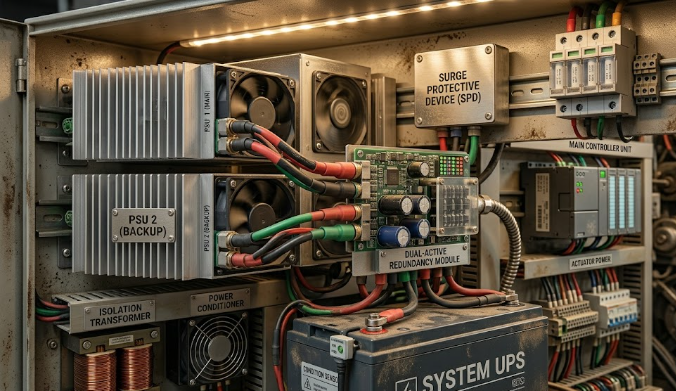
Control systems are designed to operate continuously and respond instantly to changing process conditions. A brief loss of power can have serious consequences, including:
PLC processor shutdowns
Loss of communication between devices
Corrupted process data
Unexpected equipment stops
Product quality issues
Safety system failures
Production downtime
In highly automated facilities, even a power interruption lasting a few seconds can result in hours of recovery time and significant financial losses.
Ensuring a reliable power infrastructure helps maintain operational stability while protecting valuable automation assets.
Industrial facilities face numerous electrical challenges that can affect control system performance.
Common issues include:
Voltage reductions often occur when large motors start or when heavy electrical loads are connected to the network. Sensitive control equipment may reset or malfunction during these events.
Switching operations, lightning strikes, and utility disturbances can generate voltage spikes that damage electronic components.
Variable Frequency Drives (VFDs), welding equipment, and high-power machinery can introduce electrical interference into control circuits.
Non-linear loads create harmonics that reduce power quality and place additional stress on power supplies and electronic devices.
Utility outages or internal electrical failures can cause total shutdown of automation systems if backup power is unavailable.
Understanding these risks is the first step toward improving reliability.
One of the most effective ways to improve reliability is choosing high-quality industrial power supplies specifically designed for automation applications.
Industrial-grade power supplies typically offer:
Wide input voltage ranges
High efficiency
Overload protection
Short-circuit protection
Thermal protection
Long operational life
Unlike consumer-grade equipment, industrial power supplies are engineered to operate reliably in harsh environments with temperature fluctuations, vibration, and electrical disturbances.
Investing in premium power supply equipment often reduces long-term maintenance costs and minimizes unexpected failures.
Redundancy is a proven strategy for increasing system availability.
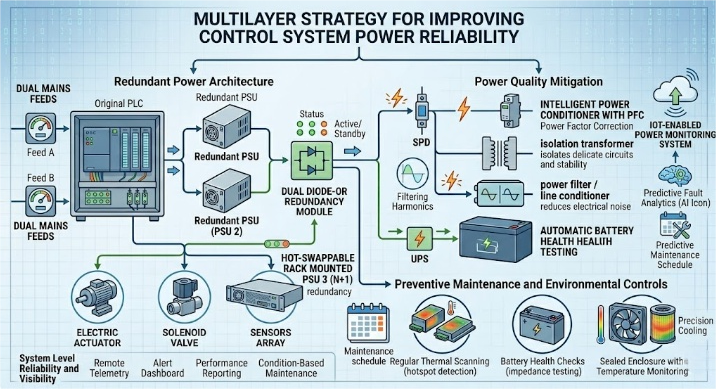
Redundant power systems use multiple power supplies operating simultaneously. If one unit fails, another automatically assumes the load without interrupting operation.
Common redundancy configurations include:
N+1 power supply systems
Dual power supply modules
Redundant DC distribution systems
Redundant UPS systems
Critical industrial applications such as power generation, pharmaceutical manufacturing, and petrochemical processing frequently employ redundant architectures to maximize uptime.
UPS systems provide temporary backup power during utility outages and voltage disturbances.
Benefits of UPS protection include:
Continuous operation during short outages
Protection from voltage fluctuations
Prevention of data loss
Safe system shutdown capability
Reduced risk of equipment damage
For PLCs, servers, industrial PCs, and SCADA systems, UPS installations can significantly improve operational resilience.
Selecting the correct UPS capacity is essential to ensure adequate runtime during emergency situations.
Poor grounding is a common cause of automation system instability.
Effective grounding practices help:
Reduce electrical noise
Improve signal quality
Prevent communication errors
Protect personnel and equipment
Recommended measures include:
Dedicated control system grounding networks
Proper cable shielding
Separation of power and signal wiring
Compliance with industrial grounding standards
Well-designed grounding systems contribute significantly to long-term power reliability.
Transient voltage spikes can destroy sensitive electronic components within milliseconds.
Surge Protection Devices (SPDs) should be installed at key locations including:
Main electrical panels
Control cabinets
Communication networks
Field instrumentation interfaces
These devices divert excess energy away from critical equipment and reduce the likelihood of costly damage.
Facilities located in regions with frequent lightning activity should place particular emphasis on surge protection strategies.
Many power-related issues develop gradually and may remain unnoticed until equipment failures occur.
Modern power monitoring solutions provide real-time visibility into:
Voltage levels
Current consumption
Frequency stability
Harmonic distortion
Power factor
Transient events
Continuous monitoring enables maintenance teams to identify problems early and take corrective action before failures impact production.
Predictive maintenance programs increasingly incorporate power quality analytics to improve system reliability.
Even high-quality power systems eventually require maintenance or replacement.
Facilities should maintain inventory of critical spare parts such as:
Power supply modules
UPS batteries
Circuit breakers
Surge protectors
Redundancy modules
Having replacement components readily available reduces repair times and minimizes downtime during unexpected failures.
Regular inspection and testing of backup equipment are equally important.
Preventive maintenance remains one of the most cost-effective methods for improving reliability.
Recommended maintenance activities include:
Thermal imaging inspections
Voltage verification
Connection tightening
Battery testing
Fan and filter replacement
Cleaning electrical enclosures
Routine maintenance helps identify aging components before they fail and extends the operational life of power infrastructure.
Organizations that adopt structured maintenance programs typically experience fewer unplanned outages and lower repair costs.
As Industry 4.0 technologies become more widespread, automation systems continue to grow in complexity and connectivity.
Emerging technologies such as:
Industrial IoT
Edge computing
Advanced analytics
AI-driven process control
Cloud-based monitoring
all place greater demands on electrical infrastructure.
Facilities that invest in reliable, scalable power systems today will be better prepared to support future digital transformation initiatives.
Reliable power supply systems are essential for maintaining the performance, availability, and safety of industrial control systems. By implementing industrial-grade power supplies, redundant architectures, UPS protection, surge suppression, proper grounding, and proactive maintenance programs, manufacturers can significantly reduce the risk of downtime and equipment failure.
As automation continues to drive industrial productivity, power reliability will remain a key factor in achieving operational excellence and long-term competitiveness.
About Easy Semiconductor Technology (Hong Kong) Limited
Easy Semiconductor Technology (Hong Kong) Limited is a trusted supplier of industrial automation products, PLC modules, DCS systems, industrial power solutions, communication equipment, and control system components. The company supports customers worldwide with reliable sourcing services, technical expertise, and innovative solutions that help improve industrial efficiency, reliability, and operational performance.