
 home
home
 Published: Jun 01, 2026 10:08 PM
 Page View: 176
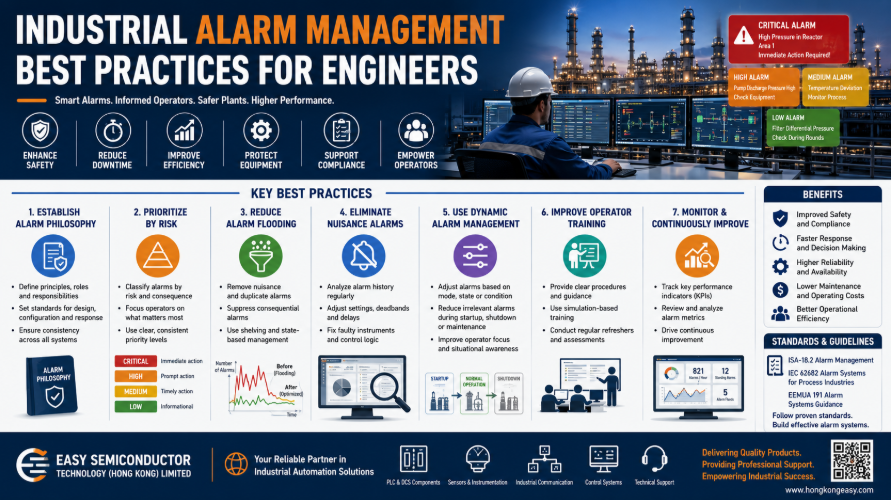
As industrial facilities continue to embrace automation and digital transformation, alarm management has become a critical component of modern process control systems. In industries such as oil and gas, power generation, chemical processing, water treatment, pharmaceuticals, and manufacturing, alarms serve as the first line of defense against operational abnormalities. When properly designed and managed, alarm systems help operators respond quickly to potential hazards, reducing downtime and preventing costly incidents.
However, poorly configured alarm systems can create alarm floods, operator fatigue, and delayed responses. Studies have shown that excessive alarms during abnormal situations often overwhelm operators, making it difficult to identify the root cause of a problem. As industrial automation systems become more complex, engineers must adopt alarm management best practices to ensure safe, reliable, and efficient plant operations.
This article explores key alarm management strategies that engineers can implement to optimize industrial control systems and improve operational performance.
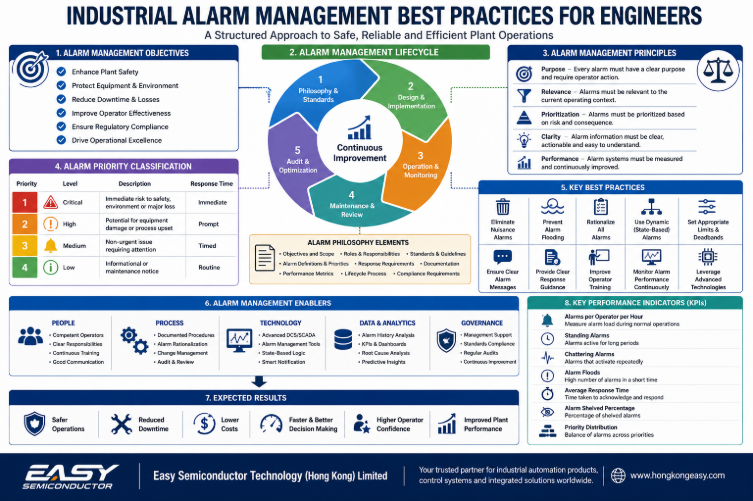
An industrial alarm is designed to notify operators when a process variable exceeds a predefined limit or when equipment operates outside acceptable conditions. Effective alarm management helps organizations:
Enhance plant safety
Reduce equipment damage
Minimize unplanned downtime
Improve operator response times
Increase production efficiency
Support regulatory compliance
Lower maintenance costs
Without a structured alarm philosophy, facilities may experience hundreds or even thousands of unnecessary alarms daily, making it difficult for operators to distinguish critical issues from routine notifications.
The foundation of successful alarm management begins with a documented alarm philosophy.
An alarm philosophy defines the standards, procedures, and guidelines for alarm creation, prioritization, configuration, and maintenance. It provides a consistent framework across the entire facility.
A well-developed alarm philosophy should include:
Alarm objectives
Priority definitions
Alarm response requirements
Operator responsibilities
Performance metrics
Alarm lifecycle management procedures
Documentation standards
By establishing clear guidelines, engineering teams can ensure consistency across Distributed Control Systems (DCS), Programmable Logic Controllers (PLC), and Supervisory Control and Data Acquisition (SCADA) platforms.
Not all alarms have the same level of importance. One of the most common mistakes in industrial facilities is assigning high priority to too many alarms.
Engineers should perform risk assessments and classify alarms into categories such as:
Requires immediate operator action to prevent safety incidents, environmental damage, or major production losses.
Needs prompt attention to avoid equipment damage or process disruptions.
Requires corrective action but does not pose an immediate risk.
Provides informational alerts and maintenance notifications.
Risk-based prioritization ensures operators focus on the most important alarms during abnormal operating conditions.
Alarm flooding occurs when operators receive an excessive number of alarms within a short period. During process upsets, hundreds of alarms may be generated in just a few minutes.
Alarm flooding can lead to:
Delayed responses
Missed critical alarms
Increased operator stress
Reduced situational awareness
To minimize alarm flooding, engineers should:
Remove nuisance alarms
Eliminate duplicate alarms
Suppress consequential alarms
Apply alarm shelving techniques
Utilize alarm state-based management
Modern alarm management software can automatically identify recurring alarm floods and recommend optimization opportunities.
Nuisance alarms are alarms that occur frequently but do not require operator action. These alarms often account for the majority of alarm system activity.
Common causes include:
Poor alarm settings
Instrumentation noise
Incorrect deadbands
Faulty sensors
Equipment cycling
Engineers should regularly analyze alarm histories to identify nuisance alarms and take corrective action.
Recommended solutions include:
Adjusting alarm thresholds
Increasing deadband settings
Implementing alarm delays
Repairing faulty instrumentation
Reconfiguring control logic
Reducing nuisance alarms significantly improves operator effectiveness.
Alarm rationalization is a structured review process used to determine whether an alarm is necessary and how it should function.
During rationalization, engineering teams evaluate:
Alarm purpose
Trigger conditions
Operator response requirements
Consequences of inaction
Alarm priority
Recommended corrective actions
Each alarm should answer a simple question:
What action must the operator take when this alarm occurs?
If no action is required, the event may not need to be an alarm at all.
Alarm rationalization helps eliminate unnecessary alarms while improving the effectiveness of critical notifications.
Traditional alarm systems often operate with fixed alarm limits regardless of plant operating conditions.
Dynamic alarm management adjusts alarm behavior based on:
Production modes
Startup sequences
Shutdown procedures
Maintenance activities
Process states
For example, an alarm that is relevant during normal production may not be necessary during startup.
State-based alarm management prevents irrelevant alarms from distracting operators and improves overall system performance.
Even the best alarm system cannot compensate for inadequate operator training.
Engineers should work closely with operations teams to ensure personnel understand:
Alarm priorities
Response procedures
Process consequences
Emergency actions
Alarm system functionality
Simulation-based training can be particularly effective.
By recreating abnormal operating scenarios, operators gain practical experience responding to alarms under realistic conditions without risking actual production equipment.
Regular refresher training helps maintain competency and preparedness.
Continuous improvement requires ongoing measurement and analysis.
Key alarm performance indicators include:
Alarms per operator per hour
Standing alarms
Chattering alarms
Alarm floods
Average alarm response time
Priority distribution
Alarm shelving frequency
Industry standards often recommend that operators receive no more than a manageable number of alarms during normal operations.
Alarm management software platforms can generate reports and dashboards that help engineering teams identify trends and improvement opportunities.
Industrial facilities increasingly use digital technologies to improve alarm management.
Advanced solutions may include:
Predictive maintenance analytics
Artificial intelligence (AI)
Machine learning algorithms
Digital twins
Industrial Internet of Things (IIoT) platforms
These technologies can detect abnormal conditions before traditional alarm thresholds are reached.
Predictive alarm strategies enable maintenance teams to address developing problems proactively, reducing equipment failures and minimizing production disruptions.
As Industry 4.0 adoption continues to grow, intelligent alarm management will play an increasingly important role in operational excellence.
Several international standards provide guidance for alarm management programs.
Widely recognized standards include:
ISA-18.2 Alarm Management Standard
IEC 62682 Alarm Systems for Process Industries
EEMUA 191 Alarm Systems Guidance
These standards define alarm lifecycle methodologies and best practices for design, implementation, operation, maintenance, and continuous improvement.
Following recognized standards helps organizations improve safety performance while supporting regulatory compliance initiatives.
Effective alarm management is far more than simply configuring alarm limits within a control system. It is a comprehensive strategy that combines engineering expertise, operator training, risk assessment, performance monitoring, and continuous improvement.
By implementing alarm rationalization, reducing nuisance alarms, prioritizing alerts based on risk, and leveraging advanced digital technologies, engineers can significantly enhance plant safety, reliability, and productivity. In today's increasingly automated industrial environment, a well-managed alarm system serves as a powerful tool for preventing incidents, minimizing downtime, and ensuring operational excellence.
Organizations that invest in alarm management best practices will be better positioned to achieve long-term performance improvements while maintaining safe and efficient operations.
About Easy Semiconductor Technology (Hong Kong) Limited
Easy Semiconductor Technology (Hong Kong) Limited specializes in supplying industrial automation products, control systems, PLC modules, DCS components, industrial communication devices, sensors, and technical solutions for customers worldwide. Through reliable sourcing, technical expertise, and responsive customer support, the company helps manufacturers improve operational efficiency, maintain equipment reliability, and support digital transformation initiatives across multiple industries.